
By Abbie Harper
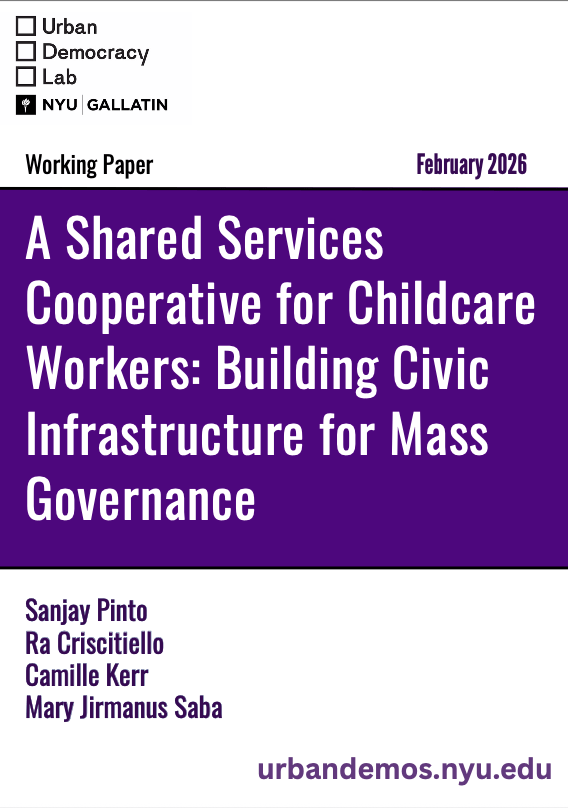
As New York City prepares to dramatically expand childcare access, a new report asks a deeper question: who should control the system? In A Shared Services Cooperative for Childcare Workers: Building Civic Infrastructure for Mass Governance, authors Sanjay Pinto, Ra Criscitiello, Camille Kerr, and Mary Jirmanus Saba propose a citywide shared services cooperative for community-based childcare providers – an institution that could help small providers succeed, strengthen worker voice, and prevent corporate capture of the childcare sector.
The report starts with the reality both childcare workers and parents know well: the current system is not working for them. Childcare providers – overwhelmingly women and disproportionately women of color – are underpaid and overworked, reflecting a long history of racialized and gendered devaluation of care work. At the same time, childcare is unaffordable for many families.
Meanwhile, private equity firms are increasingly investing in childcare chains, attracted by the steady stream of public funding flowing into the sector through government contracts and subsidies. As we’ve already seen with nursing homes, hospitals, and home care, profit-driven models are not aligned with the needs of workers, families, or communities. Without new structures in place, the childcare system could become completely dominated by large corporations.
The report’s solution is to create a shared services cooperative (SSC) for community-based childcare providers across New York City. At a basic level, the cooperative would function like a group purchasing organization. By pooling resources, small providers could access services that are currently expensive or difficult to manage – or even access – individually. These could include administrative services, professional development, insurance, and marketing. An SSC would also make it possible for independent contractors and small businesses to come together to be able to compete for larger New York City contracts.
But the proposal goes even further. The authors argue that an SSC could also become a platform for participatory democracy in the childcare system. By bringing providers together in a shared institution, the cooperative could coordinate input into policy decisions and help build collective power across the sector.
As the report begins to suggest, if we are serious about democratizing entire sectors of the economy, we also need the involvement of unions.
While an SSC could provide many of the benefits associated with collective organization – shared resources and a stronger collective voice – it would not provide collective bargaining power on its own. That raises an important question: how can an SSC strengthen, rather than substitute for, unionization?
One answer is labor neutrality.
Labor neutrality agreements require employers to remain neutral if workers choose to unionize. Employers agree not to interfere with organizing efforts and commit to voluntarily recognizing a union once workers demonstrate majority support.
If an SSC were structured with labor neutrality built into its governance, it could create fertile ground for union organizing across the childcare sector. Rather than acting as an alternative to unions, the cooperative could help build the relationships and trust that make unionization possible.
This is particularly important in sectors like childcare, where many workers are classified as small business owners or independent contractors. In these fragmented industries, workplace-by-workplace organizing can be challenging. Sector-wide institutions like a shared services cooperative could help connect workers and create new pathways toward broader union organizing.
Universal childcare has the potential to transform the lives of millions of New Yorkers. But building a truly equitable childcare system requires more than expanding access. It requires confronting the historical devaluation of care work, resisting corporate takeover of the sector, and – as the paper’s authors recommend – building institutions where workers and communities have a meaningful role in governing the systems that shape their lives. An SSC, with labor neutrality agreements built in, could be a transformational step in that direction, designed not just to deliver services, but to maximize worker power.

