How can New Yorkers build a society based on cooperation, sharing ideas and resources rather than extraction and profit?
On Thursday, September 24, the CUNY School of Labor and Urban Studies (CUNY SLU) hosted a hybrid event in partnership with the U.S. Solidarity Economy Network and RIPESS Intercontinental to discuss how New Yorkers are using Social Solidarity Economy (SSE) to build democracies in every part of life. The event coincided with Climate Week, and the UN General Assembly where the UN Inter-Agency Task Force convened to urge member states to adopt SSE as “a means of advancing sustainable development, decent work and social justice.”
Rita “Kiki” Edozie, Senior Associate Dean, Chief Academic Officer, and Professor of Urban Studies at CUNY SLU introduced a panel discussion with Sonia Dias, Waste specialist and researcher at Women in Informal Employment: Globalizing and Organizing, Ever Amar of Rocksteady Farms, Melanie Bush from the US Solidarity Economy Network, Kate Anstreicher the Associate Director of Regional Food Programs at Glynwood Center for Food and Farming, Rob Robinson from the Global Platform on the Right to the City, and Marc Edelman a Professor of Anthropology and Master’s Graduate Advisor at Hunter College and the CUNY Graduate Center, moderated by Sandra Moreno, Executive Secretary of RIPESS Intercontinental and Rebecca Lurie from CUNY SLU, Community and Worker Ownership Project.
The panelists discussed how their organizations are deploying SSE to promote hyperlocal democracy, higher wages, food security and sovereignty, community ownership, affordable housing and dignified work. Moreno asked each panelist, “how can SSE experiments be funded, and will that create greater scale for social solidarity economy practice?” Furthermore, she challenged panelists to describe what a relationship between social movements and governments need to look like to achieve SSE implementation.
Panelist Rob Robinson emphasized that social movements are the reason why law and policy favorable to cooperative businesses and community land trusts, even exist. Panelist Ever Amar highlighted that worker self-direction and democratic decision-making directly contributes to higher wages for farmers at Rocksteady compared to other agricultural workers in the state. She attributes their profitability and self-sufficiency to philanthropy and a consistent volume of CSA members purchasing cultural crops from Molokhiyya to Calalloo.
Though New York City has participatory budgeting in 22 districts and cooperative corporations laws, social solidarity economy is not a recognized framework for reducing unemployment and underemployment, creating affordable housing, and lowering the cost of living.
Social Solidarity Economy is an expansive framework that promotes building alternative economic models that prioritize social and environmental well-being over private profit. Though government officials do not explicitly name social solidarity economy as a solution to the city’s biggest problems, practitioners within the local SSE ecosystem seem to have the Mayor’s attention. Professor Stephanie Luce at CUNY SLU, and Deyanira Del Rio, Executive Director of the New Economy Project, served on the Mayor’s Transitional Committee on Economic Development & Workforce Development.
Each panelist converged to present a case for a resist and build strategy. Panelist Melanie Bush details how USSEN uses this formula to build long-lasting cooperative ecosystems from Jackson, Mississippi to Idlewilde, Michigan.
Holding the tension between mutual aid and state-backed support, two participants representing local congress members urged participants and panelists to challenge themselves to go beyond the picket line and social solidarity economy spaces to assert their solutions in the political arena, pointing to Brad Lander, Councilman Chi Ossé, and the midterm election successes of Democratic Socialists of America members.
The tension between resistance aimed at governments and community-driven development is commonplace within the social solidarity economy movement. However, Rebecca Lurie, founder of the Community and Worker Ownership Project and adjunct professor, at CUNY SLU, urges New Yorkers to consider that a just transition for a better economy is not contentious, but rather the indigenous way of the land.
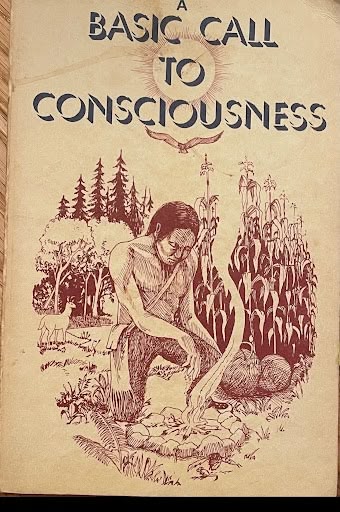
Bringing panelists and participants attention to the pre-colonial democracy and gift economy of the Haudenosaunee, the original stewards of New York and parts of Canada, she referenced the report to the UN in 1977, A Basic Call to Consciousness, sharing from that report, “The wisdom from the original inhabitants of this part of the earth were the teachers of democracy. They believed that decisions of communities should always consider the seventh generation forward, making sure our children’s children are considered in all the things we do. This is a deep sense of solidarity, beyond any one’s lifetime and place to a broader sense of responsibility to each other.”
The event was nothing short of this work. Participants included solidarity economy enthusiasts, students from the CUNY SLU Community and Worker Ownership Project, representatives from the government of Spain, workers from cooperatives based in New York, local government workers, and more.
Building on RIPESS Intercontinental’s work to advance UN Resolutions on SSE, Secretary Sandra Moreno and panelists assert that New Yorkers can build a more equitable and equal world through creating cooperative institutions, such as worker-owned and other types of cooperatives, community land trusts, public banking, credit unions, and more. They insist these forms not only become popular forms of community economic development but also scaffold a future society that is democratic and post-capitalist.
Particularly, the answers to the second question revolved around how the social movements can practically and genuinely lead and how the values of direct democracy and community ownership and governance can remain genuine and un-coopted.